This research examines whether manufactured expertise can fool AI search engines, using the MyJobQuote scandal where 11 fictional "experts" were quoted across 600+ UK media articles as a test case. When we queried nine AI models with topic-based questions like "Who are the UK's leading experts on home security?", zero fake personas appeared. But when asked directly whether specific fake names were recognised authorities, models failed 29.5% of the time, sometimes confidently inventing career histories for people who don't exist. The contrast with genuine experts is stark. Real authorities in SEO like Jason Barnard dominate AI recommendations because they've built deep, corroborated brand entities; consistent profiles, third-party validation, years of published work. The takeaway for SEOs and marketers: AI doesn't rank pages anymore, it recommends entities. You can trick a model into recognising a name, but you can't trick it into recommending that name ahead of genuine authorities. Brand building isn't optional - it's your moat.
Market Share
Get an unprecedented view of your market share by analysing your organic performance against the top 100 competitors in your niche

Imagine if there was an SEO tool that could automate this analysis
Well, imagine no longer. Using our proprietary database of commercial keywords and SERP results we can compare your performance in Google across a whole industry.
How do you analyse market share?
We simply calculate the total visibility of your site and its most common occurring 100 competitors in Google in each country and language. We then express your visibility score as a percentage of the whole market.
How do you identify competitors?
We look at the top 30 competing organic URLs for every keyword that you rank for. This generates thousands of URLs from thousands of different sites. So, we then define the market by narrowing it to the top 100 competitors who have the greatest SEO visibility for keywords in common with you.
We can also start with a list of competitors that you specify which ensures the utmost relevance.
What is the formula for calculating Market Share?
SEO Visibility Score for your website divided by the Total SEO Visibility Score for the whole market. The whole market is either the top 100 competing sites, or, a list of specific competitors that you have defined.
SEO Visibility Score uses an industry standard method of calculation, taking the monthly search volume for a keyword and applying a click-thru rate curve based on a site’s ranking position. This is fair, as sites that rank higher get a larger score, but the score is weighted to cater for the fact that some keywords have much greater search volumes than others.
The best way to benchmark your SEO performance for keywords that matter
Not all of your competitors' keywords are relevant to you.
This is especially true in eCommerce where you will be competing with Amazon and eBay who rank for millions of irrelevant terms.

An accurate Share of Search% you can rely on
Most SEO tools take a primitive approach to analysing Share of Search. It’s either based on too few keywords (e.g. Just your ranking keywords) or too many (e.g. Including all of Amazon or eBay’s keywords not just the relevant ones).
We define your market as:

Answering tricky SEO questions from your CEO or CMO
Choose from 40 major international markets and automate your market study to answer questions such as:

Detailed insights even in niche markets
Market Share is designed to provide unparalleled intelligence into the largest of markets whether it's B2B, B2C or DTC.

Competitor targeting and benchmarking
In addition to comparing market share by SEO visibility, you can also drill into specific competitors’ data:

Big Data customisation options
For our Enterprise clients we can really take a ‘no stone unturned approach’ and create the definitive view of a market.

FAQs about Market Share?
All you need to know about Market Share.
Is market penetration the same as market share?
No. Market penetration is the percentage of a market’s potential buyers that have actually bought the product. Market share, on the other hand, is the percentage of a market’s sales that are generated by a particular product.
Typically, market penetration and market share are used interchangeably, but they are not the same thing. Market penetration is a measure of how much of the total potential market a product has captured. e.g. The number of units of a product sold in relation to the total number of units that could be sold.
Market share, on the other hand, is a measure of how much of the market a particular product or company has captured relative to its competition. e.g. The percentage of a market's total spending or revenue that is captured or generated by a particular product or company. In the Digital Marketing industry, Market Penetration could examine who has shipped the greatest proportion of the total number of SEO software licences sold, whilst Market Share might look at who has the greatest proportion of revenues from sales of software, or services, or the greatest slice of organic visibility.
How often are keyword rank checks updated?
The initial analysis we provide you is based on our proprietary big database of over 125mn commercial keywords. We update the keywords in the database on a daily basis and the whole database is refreshed once a month.
We can customise the keywords that you define in your markets and update them weekly or daily in our keyword rank tracking solution.
Do you have your User Intent and Universal SERP features in Market Share yet?
We include user intent information for all keywords found in the market where our algorithm has been able to establish enough signals from the SERP for a keyword to establish a user intent score.
Please check with the team to see if all Universal Search features have been enabled for your market.
What are some market penetration strategies?
There are a few different market penetration strategies that can be used in order to increase market share for a product or service. One common strategy is to offer a product or service at a lower price than the competition. This can be done by decreasing the cost of production, reducing overhead costs, or offering promotional discounts.
Another common strategy is to increase the advertising and marketing spending for the product or service. This can be done by increasing the budget for traditional advertising methods, such as television, radio, and print ads, or by allocating a larger portion of the budget to digital marketing methods, such as social media, search engine optimization, and email marketing.
A third strategy is to focus on expanding the target market. This can be done by targeting new demographics or geographies, or by developing new products or services that are more appealing to certain consumers.
How do you analyse market share?
In order to analyse market share, you must first understand what it is. Market share is the percentage of a market that is owned by a particular company.
This can be determined by dividing the company's total sales revenue by the total sales revenue of the entire market. Or in SEO terms, how big a share of all searches or clicks it is capturing (ranking for).
There are a few different ways to analyse market share. The first way is to look at it historically. This can be done by looking at the company's market share over a period of time.
The second way is to look at it geographically. This can be done by looking at the company's market share in different countries or regions.
The third way is to look at it by product category. This can be done by looking at the company's market share in different product categories.
How many countries do you cover?
You can now analyse your market share in 50 countries.
Featured Posts from our blog
Expert content from our team and our friends. Read our original SEO research studies, news about our software, algorithm updates, SEO advice and opinion.
Introducing our new free tool to convert exported Google Search Console keyword data into AI-ready question prompts, going beyond the traditional regex approach of filtering for "how", "what", "why" queries. The tool analyses up to 1,000 GSC queries, automatically generates natural language prompts, and supports multilingual output with English translation options - making it particularly useful for international SEO teams. The core argument is that since no AI platform currently releases reliable first-party prompt volume data, starting with keywords where you already have proven Google performance (impressions and clicks) provides a more meaningful baseline for AI search optimisation than guessing at prompt demand.

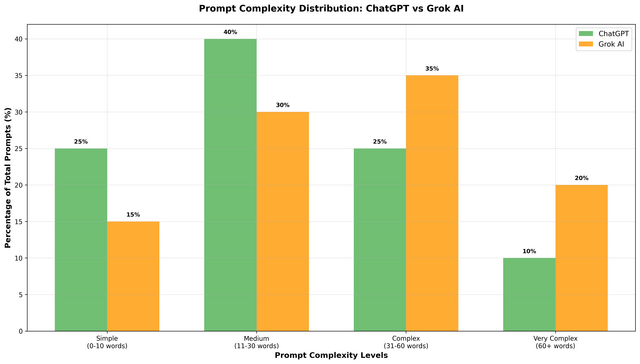
Analysis of 1.5 million ChatGPT conversations and 10,000 Grok AI interactions reveals a fundamental shift in how people use AI, from simple search-style queries to complex, conversational interactions, with ChatGPT usage flipping from 47% work-related to 70% personal use since launch. The research shows distinct platform personalities emerging: ChatGPT users favour direct, task-oriented prompts (65% simple to medium complexity) for practical advice and writing help, while Grok users engage in longer, exploratory discussions (55% complex prompts, 83.8% open-ended questions). Crucially for SEOs, this data demonstrates that optimising for AI visibility now requires moving beyond keyword-based strategies to conversation-based optimisation that supports natural language queries averaging 30+ words.